
A Sauce Is the Dish's First Decision
Here is the argument I want to defend: a classic French sauce is not the finishing touch on a plate. It is the first decision the kitchen makes. Before a cook selects the cut of duck or the fillet of hake, the sauce base is already sketched in the mind, because it sets the plate's moisture, its acidity, and the temperature contrast the diner will register long before naming the protein.
Watch the sequence in a serious brasserie kitchen and the priority becomes obvious. Foundational stocks simmer for around 12 to 14 hours before any reduction begins, and the sauce base is prepared a day or two ahead of a single dinner service. Nobody builds that timeline for a garnish.
The problem for diners is one of language. A menu names its sauces with confidence — beurre blanc, sauce au poivre, jus, but it rarely tells you when the sauce reaches the plate, or why that timing was chosen. That gap is what this guide closes.
What "Classic French Sauce" Actually Means
Strip away the reverence and a classic French sauce is a prepared, intentional component that changes how a dish eats. It contributes moisture, richness, aroma, binding, contrast, or a final lift. It is rarely there to look pretty.
The framework most people half-remember comes from the Escoffier codification, formalized in the early 1900s, which organized the repertoire around thickening agents and liquid bases so that training could be standardized across large brigade kitchens. From that scaffolding come the five commonly cited mother sauces: béchamel, velouté, espagnole, tomato, and hollandaise. The mother-sauce concept is a teaching structure, not a complete map of what a modern kitchen actually pours — a distinction worth holding as we go.
The ratio underneath the theory is almost austere. A classic mother sauce leans on roughly 1 part roux to 10 parts liquid by weight. Everything else is technique and restraint.
Brasserie menus, meanwhile, live largely outside that family tree. Beurre blanc, béarnaise, aioli, pan jus, and wine reductions all earn their place on the plate without belonging to the original five.
The Five Mother Sauces, Read by Plate Moment
The useful way to read these sauces is not by recipe but by when they arrive.
Béchamel: integrated, not poured
Béchamel almost always shows up as a binding or baking sauce. Think gratins, croque preparations, layered baked dishes, creamy fillings. It rarely reaches you tableside; instead it is folded into the assembly and baked into gratins at temperatures above 375°F for 15 to 20 minutes. By the time it reaches the table, it is part of the architecture.
Velouté: support beneath the main event
Velouté appears with poultry, fish, and delicate meats when a cook wants a pale, stock-based sauce that supports rather than dominates. It often sits beneath the protein or lightly coats it. Its viscosity comes from a blonde roux cooked for two or three minutes — and, notably, from no heavy cream at all.
Espagnole and the demi-glace lineage
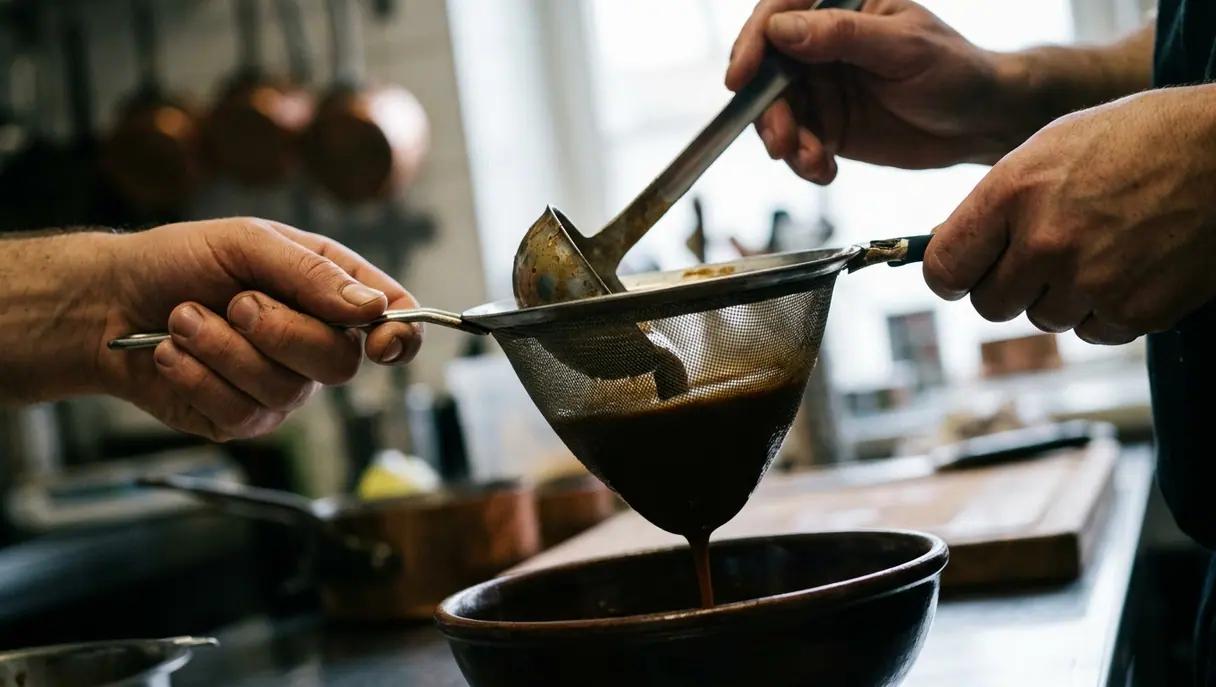
You will almost never meet espagnole by name. What you meet, in practice, are its descendants: brown reductions, meat jus, and glossy sauces built for beef, duck, and braised dishes. The lineage matters more than the label here. A proper demi-glace reduction takes the better part of a day or two to reach the gelatinous consistency that coats the back of a spoon, which is why the deep, savory sauces beside a braise carry so much weight.
Hollandaise, the outlier of the five, is a matter of thermal discipline. It is held in a warm bain-marie between 120°F and 145°F and applied at the pass, because any hotter scrambles the yolk and any cooler breaks the emulsion.
The Brasserie Sauces Diners Actually Meet
Brasserie chefs took the classical grammar and rewrote it for speed. High-volume, rapid-turnover rooms demanded à la minute pan sauces, and three of them dominate the tables of Back Bay and Newbury Street.
- Beurre blanc. A butter-and-wine emulsion that arrives with fish or shellfish when the dish needs acidity without heaviness. It is fragile work: three or four minutes of aggressive whisking over medium-low heat to fold cold butter cubes into a white-wine reduction.
- Béarnaise. Hollandaise's more assertive cousin — an egg-butter emulsion flavored with tarragon and shallot. It lands beside steak frites and grilled beef because it delivers fat and herbaceous lift in the same spoonful.
- Sauce au poivre. The steak sauce that echoes the sear, built on pepper heat and a cognac-style depth so the plate reads as a single idea rather than two.
The pan jus threading through all of this is the fastest sauce on the plate. It is deglazed and reduced in a minute or two while the protein rests, the sauce and the resting meat finishing on the same clock.
Under, Over, Beside: Why Placement Matters
Where the sauce sits is not aesthetics. It is a decision about texture and temperature.
Sauce underneath
Pooling a sauce beneath the protein protects the texture on top while seasoning each forkful from below. Expeditors do this deliberately with crispy-skinned fish: plating the sauce underneath a pan-roasted fillet preserves the sear for the few minutes it takes to reach the dining room. The crunch survives the journey.
Sauce over the top
A sauce spooned over the top signals coating, comfort, immediate aroma. This is the language of gratins, stews, and certain poultry preparations, where the sauce is meant to saturate rather than contrast.
Sauce beside the food
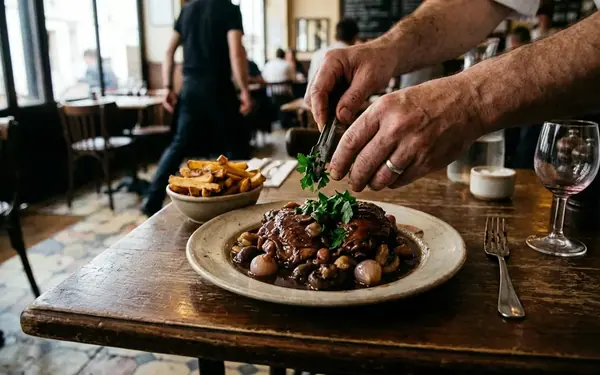
Sauce set to the side hands control to the diner, which is why it shows up with steak frites, fries, shellfish, and rich emulsions. When served this way, it is typically portioned into small ramekins — enough to dip and dose at will.
Critical Insight: The same protein tells two different stories depending on placement. Sauce shifts from over-the-top for a braise to underneath for a crispy-skinned fillet, and the diner's whole experience turns on that choice.
Pair the Wine to the Sauce Before the Protein
The pairing instinct most diners carry — heavy red for beef, crisp white for fish, mistakes the protein for the driver. The sauce is usually the driver. Butter, acidity, pepper, tomato, herbs, and reduction all redirect the glass more decisively than the cut of meat.
Sommeliers match the wine's acid structure to the dominant fat in the sauce rather than to the protein, precisely to keep the palate from fatiguing halfway through the plate. High-acid white wines, often aged a few years, are chosen to cut the butterfat of a béarnaise. Red-wine reductions, by contrast, want tannins that have softened over several years in the bottle so the sauce and the wine meet as equals.
Tomato-based sauces demand acidity in the glass, or the wine tastes flat and hollow beside the fruit's brightness.
One honest caveat lives here: pairing to the sauce breaks down when the protein is heavily charred or smoked, because that char overpowers the liquid component and takes the pairing back into its own hands.
Three Misreadings That Make French Sauces Seem Harder Than They Are
That classic means heavy. Many of the classics are light, sharp, or purely stock-based. A velouté carries zero heavy cream and gets its body from a roux cooked for two or three minutes. Weight is a choice, not a definition.
That sauce is decorative. In a great many dishes the sauce is the cooking medium, the binding agent, or the temperature contrast — the reason the dish holds together at all, not a flourish added after.
That the named protein tells the whole story. Menu writers frequently drop the stock base to save space, which nudges diners into assuming every French sauce leans on cream or butter. The reality is quieter: properly executed tomato sauces simmer for the better part of an hour to reduce water without a drop of dairy. Kitchen practice across brasserie service bears it out.
A Short Plate Glossary for the Next French Menu
This glossary is organized by what you can see and feel on the plate rather than alphabetically, so you can read the dish in real time:
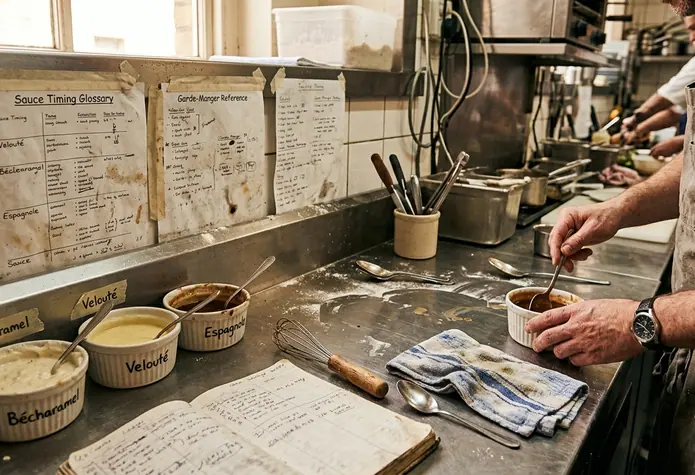
- Creamy baked sauce — béchamel, integrated during assembly.
- Pale stock sauce, velouté, beneath or lightly coating.
- Brown reduction, the espagnole and demi-glace lineage, beside beef or braise.
- Tomato base, bright, dairy-free, acid-forward.
- Warm egg-butter emulsion, hollandaise or béarnaise, applied at the pass.
- Cold aioli, a cold emulsion held just above fridge temperature before service.
- Butter-wine emulsion, beurre blanc, with fish or shellfish.
The promise underneath all of this is simple. You can read a French dish by asking one question: when did the sauce enter, during cooking, beneath the food, over the top, beside it, or at the final moment at the pass?
Escoffier's framework hands diners exactly five mother sauces to remember. A single brasserie plate can reveal any one of them in a single spoonful — béchamel, velouté, espagnole, tomato, or hollandaise, and once you taste for the moment it arrived, the whole dish stops being a mystery.


Your Comment