
Thirty-Five Parts per Thousand Is the First Pairing Clue
Start with the ocean. NOAA’s explanation of average ocean salinity notes a baseline of about 35 parts per thousand. That persistent marine imprint follows shellfish straight to the dining room. When you pour a glass of wine alongside briny seafood, that salt content acts as a magnifying glass for the wine's structural components.
A bottle that tastes perfectly balanced on its own can suddenly turn flat, bitter, or metallic beside a bowl of mussels. The solution requires looking past the protein. You have to choose a wine based on salinity, acidity, sauce, and texture rather than by seafood category alone. Counteracting that salinity without the wine tasting flat requires a specific chemical tension, typically found in wines with acidity in the range of 3.0 to 3.5 pH.
Ask Four Questions Before You Pour
Diners usually have a couple of minutes to review the wine list before the initial server inquiry. Instead of defaulting to a generic white wine, structure the decision around four specific questions.
First, identify the dominant profile: is the dish briny, sweet, oily, fried, creamy, tomato-based, or spicy? Second, evaluate the hierarchy of the plate. Determine if the sauce is lighter than the seafood or if it acts as the dominant flavor. Third, decide what the plate actually needs to achieve balance. Ask whether the combination requires acidity, bubbles, mineral tension, fruit, or a touch of sweetness.
Finally, consider temperature mechanics. High-acid whites hit their optimal expression around 45 to 50°F. Fuller-bodied options need a slightly warmer 50 to 55°F to reveal their complexity.
For Mussels, Match the Broth Before the Shellfish
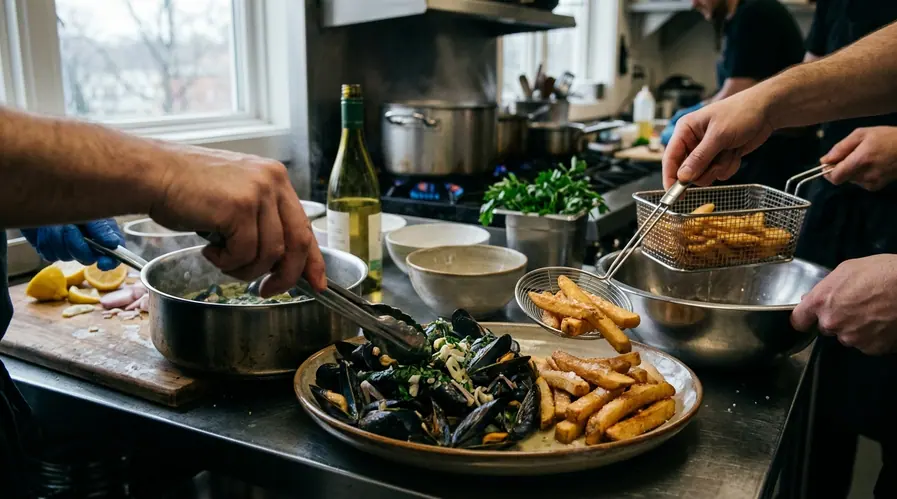
Standard mussel steaming times run just three to five minutes. This brief cooking window infuses the broth rather than altering the protein's core structure. Because delicate mussel meat is easily overpowered, the cooking liquid dictates the pairing direction.
Classic and Cream Preparations
For classic moules marinières, the broth demands acidity and saline lift. Muscadet, Picpoul de Pinet, Chablis, Sancerre, or a dry sparkling wine provide the necessary tension. Cream-based mussels require richer but still fresh whites. Unoaked or lightly oaked Chardonnay, white Burgundy, or dry Chenin Blanc carry enough weight to handle the dairy without exhausting the palate.
Tomato and Spice Profiles
Tomato, garlic, and herb broths shift the requirement toward Provençal rosé, dry Italian rosato, Vermentino, or Albariño. If the kitchen leans into chile-accented broths, look for off-dry aromatic whites. A touch of residual sugar in these wines effectively tames the heat without clashing with the brine.
Frites, Aioli, and the Need for Cut
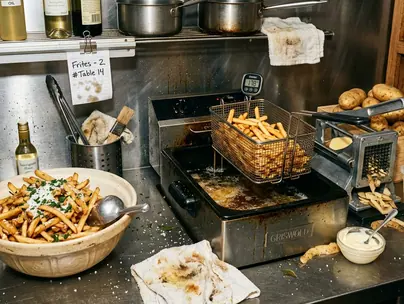
A side of frites fundamentally changes the pairing logic. The double-frying process—an initial blanch around 325°F and crisping near 375°F—creates a dense lipid layer. Add a traditional aioli of one to two egg yolks per cup of oil, and the palate quickly accumulates salt, starch, and fat.
This combination demands mechanical cleansing. Carbonation or high chemical acidity prevents palate fatigue. Sparkling wine, Champagne, Crémant, dry Chenin Blanc, Grüner Veltliner, or a sharply cut Sauvignon Blanc slice through the richness. The bubbles physically lift the fried texture, while the sharp mineral tension keeps the heavy emulsion of the aioli from feeling sluggish.
Pairing the Rest of the Seafood Plate
Beyond the mussel pot, secondary seafood offerings require categorization by fat content and structural delicacy. Raw oysters are best within about 15 to 20 minutes of shucking to retain their natural liquor. Match that fleeting brine with Muscadet, Chablis, Champagne, or a very dry sparkling wine.
Risk Factor: Raw shellfish availability and handling protocols vary significantly by season and venue; pairing advice cannot substitute for basic food-safety judgment regarding sourcing.
Delicate white fish preparations align well with Albariño, Vermentino, Chablis, Pinot Blanc, or a restrained Sauvignon Blanc. Robust preparations like oily fish need wines with sufficient weight. Salmon or mackerel pair beautifully with rosé, blanc de noirs Champagne, or dry Riesling. When the preparation allows, serving light-bodied reds slightly chilled, around 55 to 58°F, offers a brilliant counterpoint to oily fish.
How to Order Wine at a Boston Brasserie Table
A typical multi-course brasserie meal runs roughly an hour to an hour and a half. The table often transitions from four-ounce raw bar starters to 12-ounce roasted mains within a single seating. Navigating this progression requires versatile bottles that bridge multiple flavor profiles.
- Scenario 1: Two people sharing mussels, frites, and a salad. A bottle of Muscadet, Chablis, Sancerre, or Crémant covers the entire spread effortlessly.
- Scenario 2: A mixed table ordering oysters, mussels, roast chicken, and steak frites. Champagne, Crémant, or a versatile white Burgundy possess the structural integrity to handle both the delicate brine and the roasted proteins.
- Scenario 3: Seafood with cream sauce and lobster. Move toward Chardonnay, white Burgundy, or a dry Chenin Blanc with enough body to mirror the richness of the dish.
Common Pairing Mistakes That Make Seafood Taste Worse
Certain chemical clashes ruin seafood pairings entirely. Avoid tannic reds with briny shellfish. The tannins interact with iodine to produce undesirable metallic off-flavors—something years of tasting through beverage programs bear out.
Oak aging of a year to a year and a half in new barrels imparts vanilla and toast notes. Pairing a heavily oaked, long-barreled Chardonnay with raw oysters results in a metallic, bitter clash that masks the natural brine. Avoid heavily oaked whites with delicate mussels unless the sauce is rich enough to carry the wood and butter tones.
Temperature mismanagement also destroys a good pairing. Over-chilling white wines below 40°F mutes aromatic compounds and alters texture. Too much cold strips a serious white wine of its complexity, leaving it tasting like acidic water.
The Simple Table-Side Method
Diners typically face a 30 to 60-second decision window when the server asks for beverage choices. Synthesizing the pairing logic into a rapid mental checklist relieves the pressure. Evaluate three primary dish components: sauce, fat, and salt.
Recommendation: Identify the dominant sauce or broth, assess the fat content from fried items or heavy cream, and account for salt and brine before selecting wine acidity and body.
Once you identify the dominant sauce, measure the fat content, and account for the salt, you can accurately select the required wine acidity and body. When uncertain, choose a dry high-acid white or sparkling wine before committing to a richer bottle.
Critical Insight: Briny seafood needs freshness; frites need cut; cream needs body; spice may need aromatics or gentle sweetness.
Look at the menu right now, locate the exact sauce your seafood is cooked in, and point the server toward the highest-acid white wine available by the glass.




Your Comment